
Glite LENS
A bi-encoder for matching English words in context to their meanings.
Glite LENS uses two independent ModernBERT-base encoders, 298 million parameters in total: one for the target word in context and one for each candidate definition. Definitions are embedded once; inference encodes the context and compares it with the cached vectors. The released model is trained on GPT-5.5-relabeled SemCor.
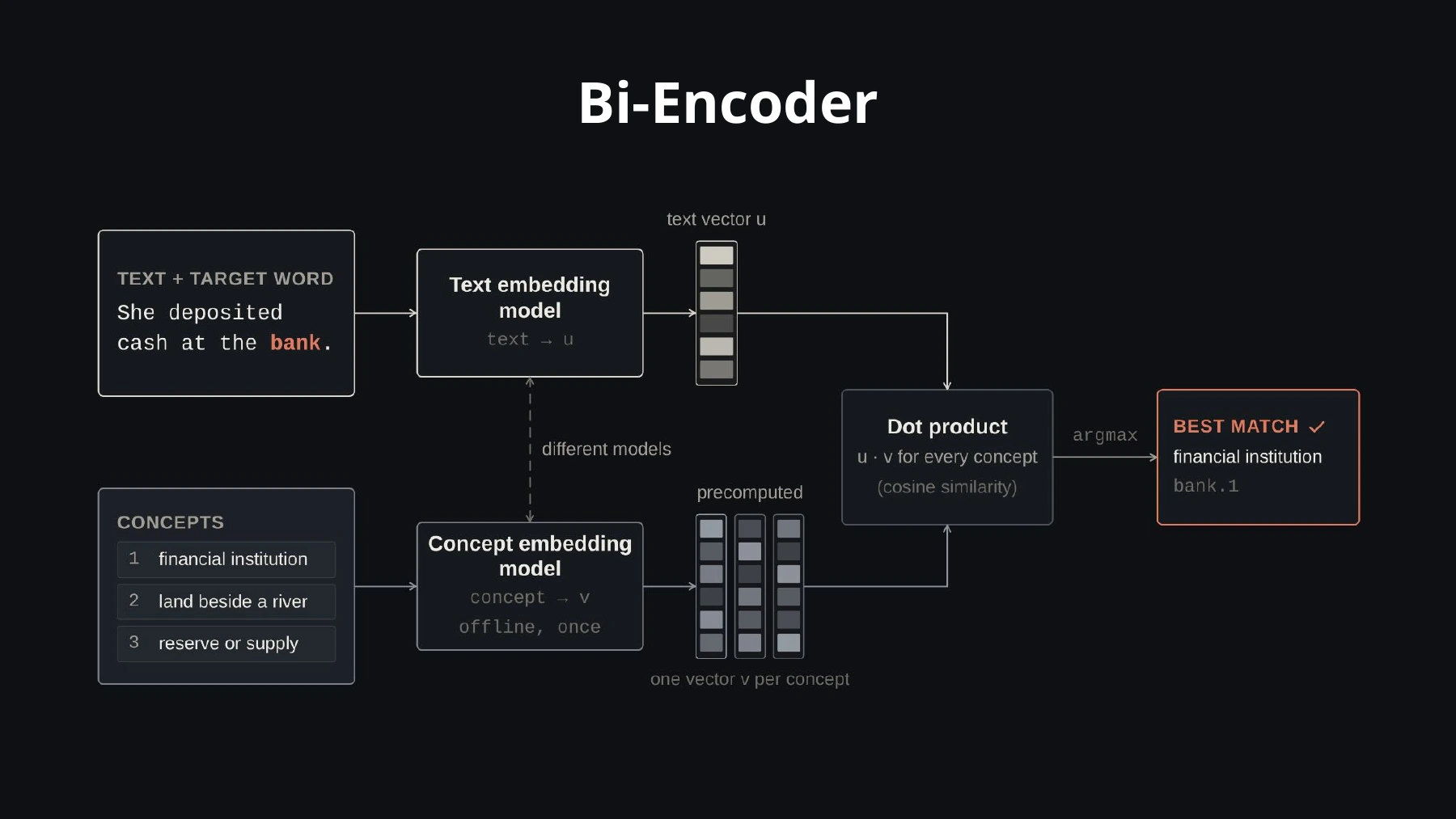
The canonical paper results average three training seeds: 83.64% micro-F1 on Raganato ALL, 87.37% on Maru ALL_NEW and 90.48% on lexEN. The original-label control scores 80.84%, 82.14% and 83.52%, respectively. The paper reports the Raganato result as the strongest published bi-encoder result it identifies; it is not the highest WSD result across all model families.
For a direct comparison with the live LLM leaderboard, SenseBench separately scores the published LENS predictions at 89.69% on its 4,861 lexEN items. On that same fine-grained evaluation, ConSeC scores 84.88% and GPT 6 Astra reaches 95.66% in the 25 September 2026 snapshot. Use that matched comparison rather than substituting the paper’s 90.48% three-seed result.
The measured inference cost is $0.126 per million disambiguations, about 0.9 milliseconds per item, on one RTX 5090 with batched bf16 inference and a precomputed definition gallery. This is steady-state GPU rental cost, with model loading excluded, rather than a hosted API price. Code, checkpoints, per-item predictions and the benchmark configuration are released in the reproduction repository.