
Reinforcement learning in education
Teaching is a sequence of decisions. The next activity should depend on what a learner knows, what they need to learn and what earlier activities changed.
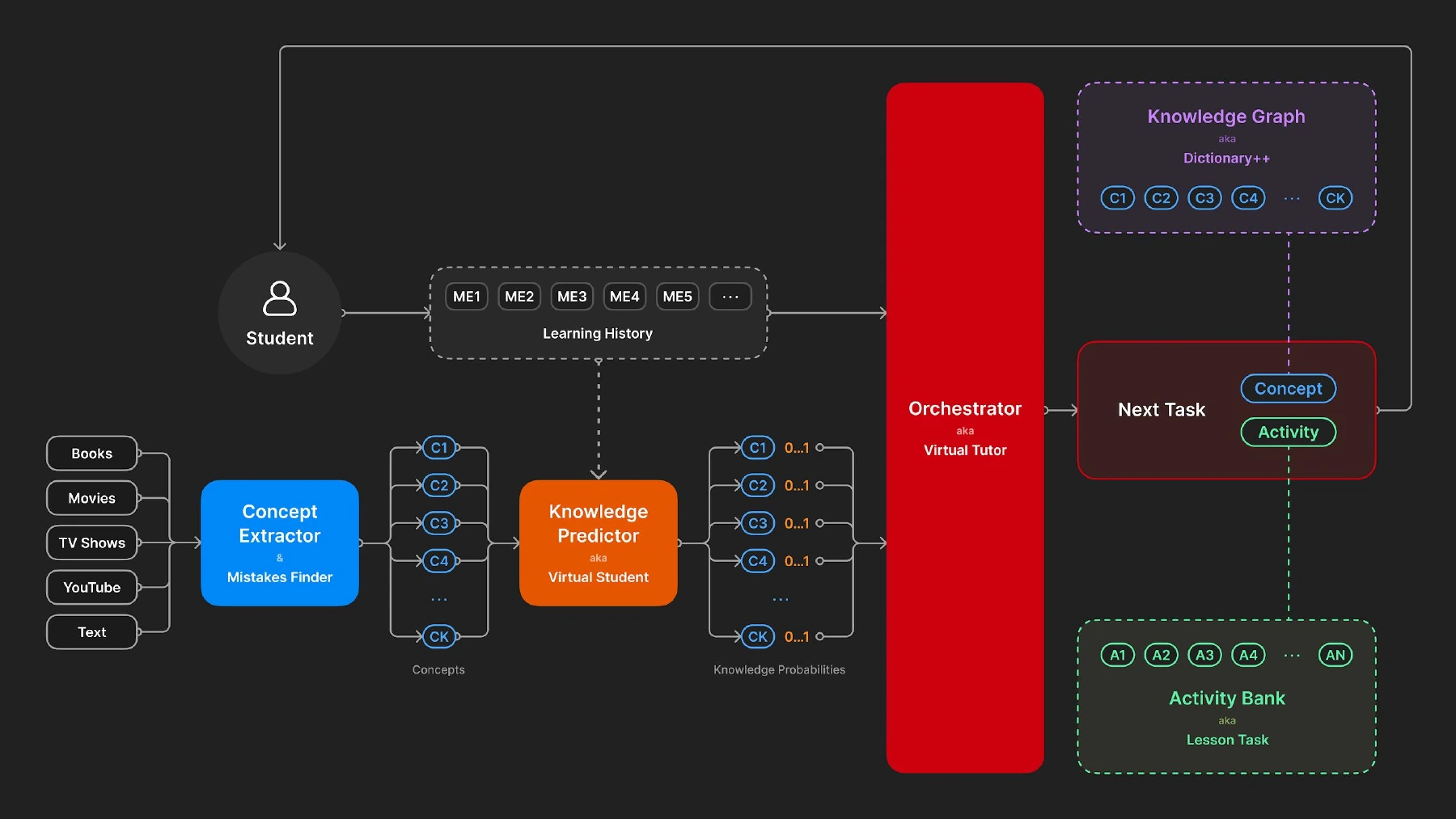
The learner answers questions and completes activities. Their responses provide evidence about what they know.
A record of answers and learning activities. The models use this history to update estimates and choose the next task.
Books, videos and other content contain learning concepts. Identifying those concepts connects materials to a learner’s needs.
Identifies the learning concepts in content and student answers: word meanings, expressions, skills and misconceptions.
The units the system recognises and teaches. For English, these include individual word meanings and expressions.
The Knowledge Prediction model combines concepts with a learner’s history to estimate what that learner already knows.
Estimates between zero and one express uncertainty about a learner’s knowledge of each concept. They can change as new evidence arrives.
Selects the next concept and activity using learning history, knowledge estimates and the available tasks.
Organises the concepts that can be taught. Depending on the domain, it may include explicit relationships or a collection of concepts without them.
Pairs a learning concept with an activity. The learner’s response becomes part of the history for the next decision.
The available learning activities: different ways to practise, explain or assess a concept.
Teaching is a sequence of decisions. The next activity should depend on what a learner knows, what they need to learn and what earlier activities changed.
A student’s answer is evidence about their knowledge. It is not a complete description of it.
We give the concept extractor text, audio or video, and it identifies the learning concepts.
A learning system needs an explicit account of the concepts it can teach.
A model benchmark answers one question. A classroom trial answers another.
Research automation needs verifiable experiments and an inspectable record of what happened.