
Glite English Dictionary
Glite Dictionary is organised around individual meanings. Each sense has its own page, so the definition, examples, images, audio, video, difficulty and frequency can all describe the same thing.
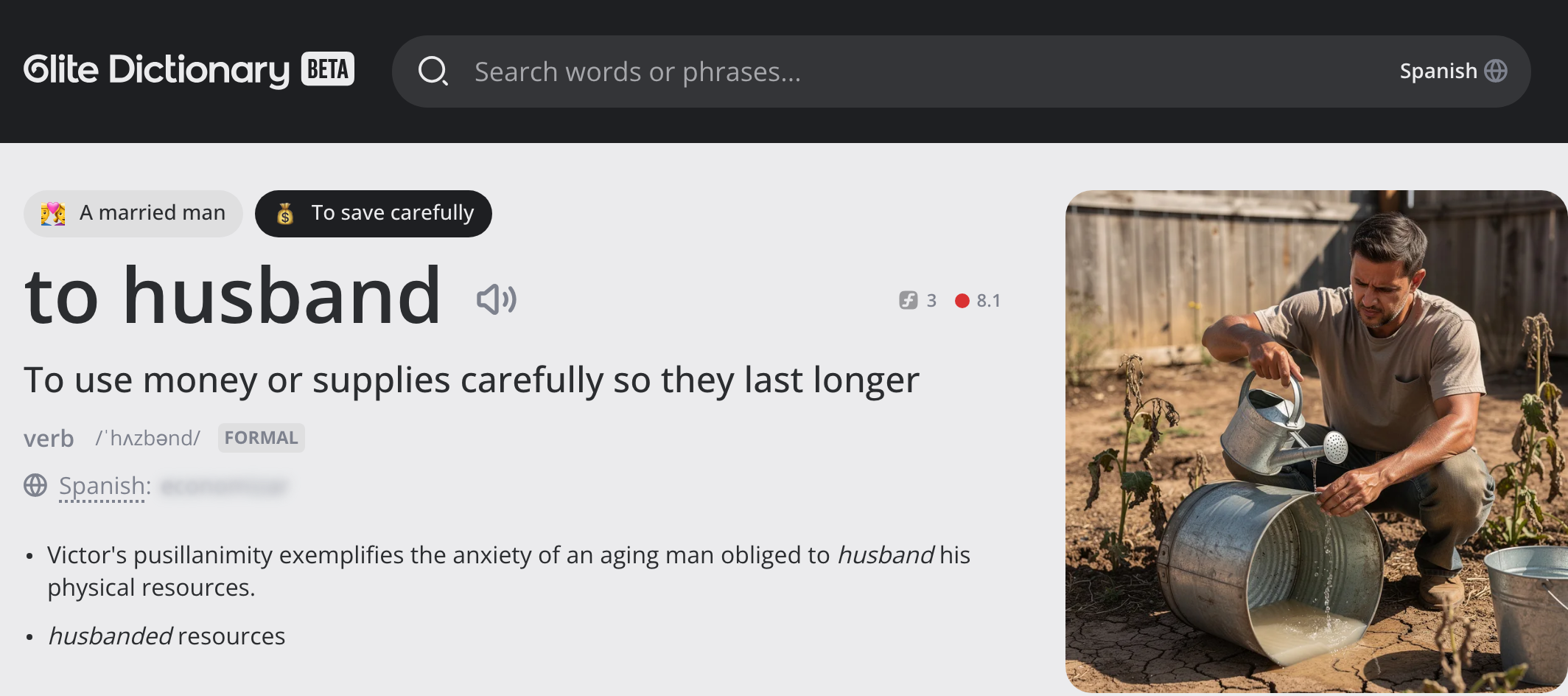
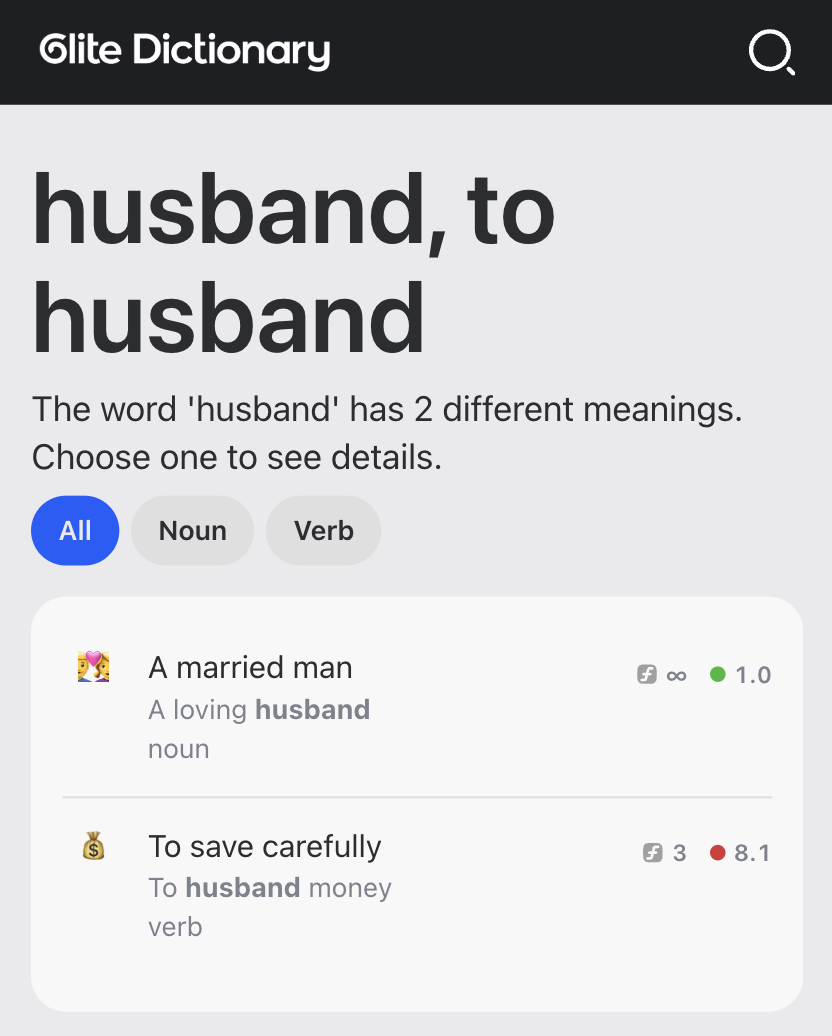
That matters particularly for intermediate and advanced English. You may recognise every word in a sentence and still miss its meaning. Knowing husband as a married man does not mean knowing the verb in “They husbanded their resources”: they used those resources carefully. A learning system needs to keep those two pieces of knowledge separate.
One page for each meaning
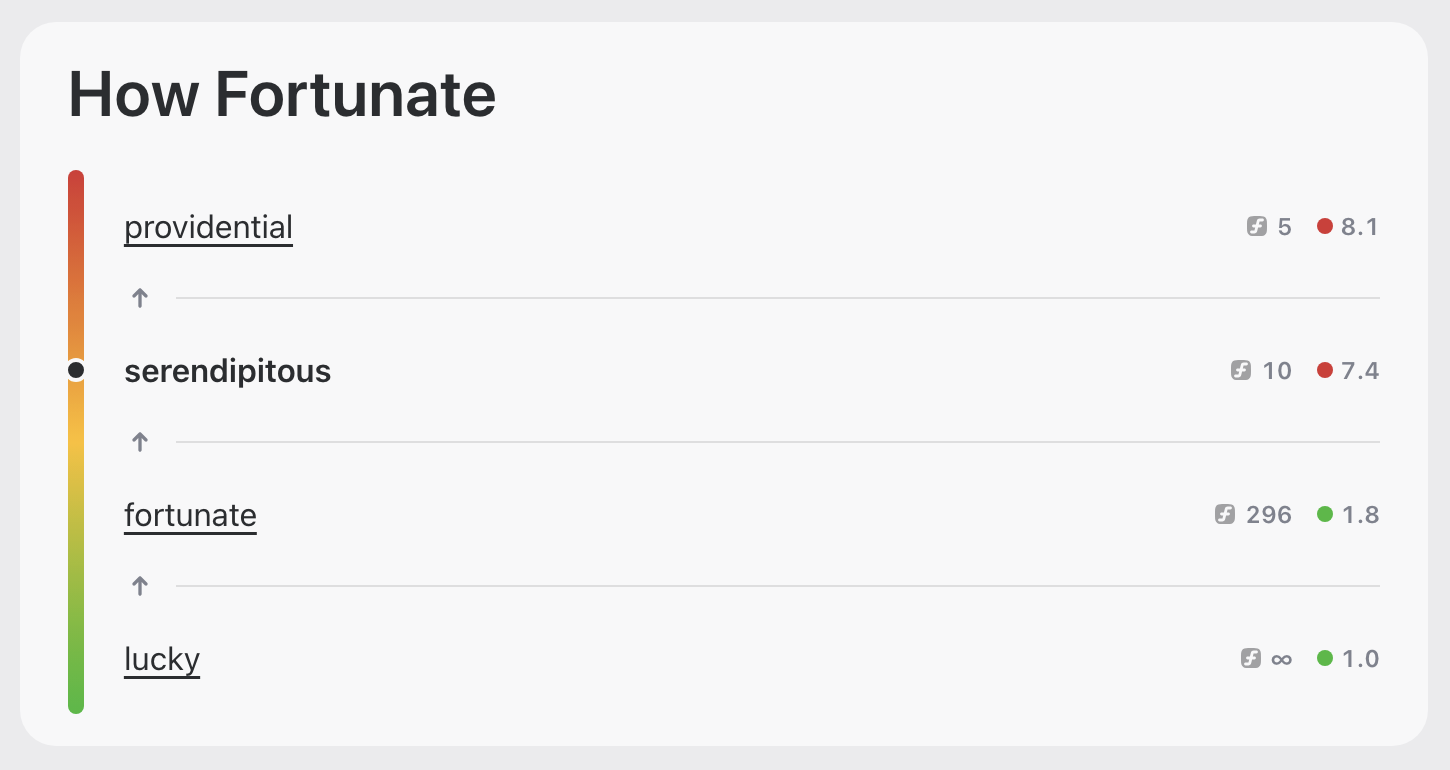
The distinguishing feature is the combination of information attached to a sense. A page can bring together a definition, translations, forms, examples and a picture of that meaning. Video and natural speech show how it appears in use. Explanations of synonyms help you choose between nearby words; semantic scales show differences in strength. These are different ways of understanding the same concept, gathered in one place. See the dictionary’s feature overview.
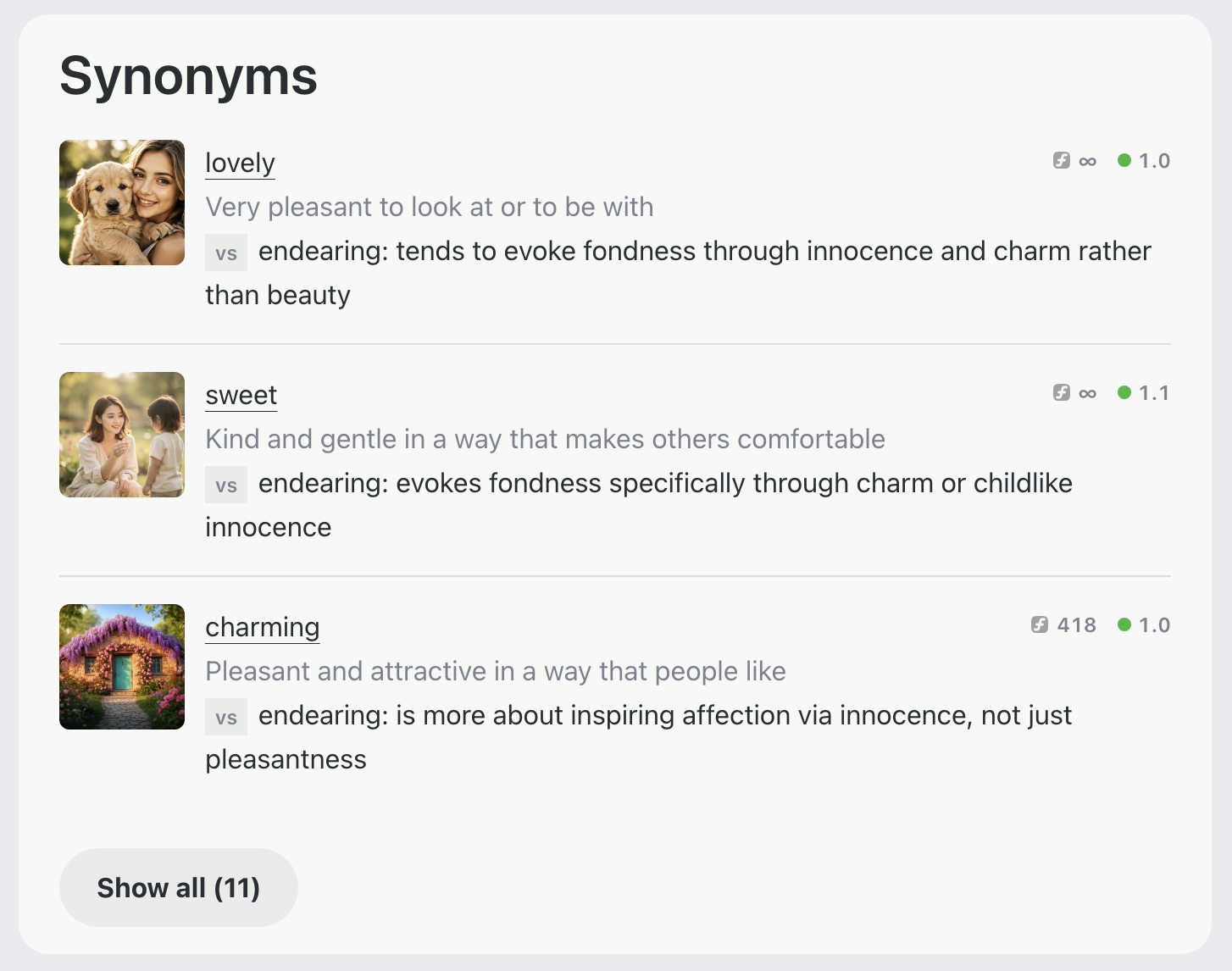
For a learner, this reduces a familiar problem: finding the right entry but reading an explanation of the wrong meaning. For an educational system, it provides an explicit unit to identify, practise and assess. A record that someone knows one sense need not imply that they know every use of the word.
Difficulty from vocabulary-test responses
Glite uses responses to its Vocabulary Test as evidence about which meanings people know. The dictionary presents difficulty on a scale from 1.0 to 9.9, with larger numbers indicating harder meanings. Some senses have direct test evidence; others have predicted difficulty. The distinction matters: an estimate for an untested meaning is not a measurement from people answering a question about it. The difficulty methodology explains the learner-facing score.
Why a percentage is not enough
Suppose one meaning is shown mostly to advanced learners and another mostly to beginners. Their raw recognition rates cannot tell us which meaning is harder. We need to account for differences between the people who saw them.
Item response theory (IRT) models a response using both the learner’s ability and the item’s difficulty. In a simple Rasch model, the probability of success increases as ability rises relative to difficulty. More elaborate models can also represent how strongly an item distinguishes between ability levels, guessing and imperfect performance. The Stan guide to IRT gives the mathematical formulation.
This gives difficulty a more useful interpretation than “the percentage who got this question wrong”. It still depends on the test and its respondents. Recognising a meaning in a sentence, recognising a spelling without context, and producing the word while speaking are different tasks. A score calibrated on one should not silently become a claim about all three.
The 1.0–9.9 badge is a presentation scale. A score of 8 does not mean a word takes twice as long to learn as one scored 4, and it does not mean that a particular learner has an 80% chance of missing it.
First-language differences
Learners with different first languages can find different English words difficult. Our BEA 2026 vocabulary-difficulty research examines this for Spanish, German and Mandarin speakers. It combines linguistic and dictionary features with predictions from models trained to estimate difficulty. The submission placed first in the closed track and second in the open track for all three languages. Read the published paper.
That study supports the broader research into predicting difficulty. Its competition scores are separate from the dictionary’s public badges; they are not a validation of every sense’s displayed estimate.
Frequency of meanings and expressions
Frequency answers a different question: how often does this meaning occur? Counting a spelling combines its senses, which can hide large differences in use. The same issue arises with expressions: the frequency of their individual words does not tell us how often the expression appears.
The frequency pipeline retains counts and source sizes for each concept and source type. Dividing occurrences by the number of words, then multiplying by a million, makes corpora of different sizes comparable. Keeping the source categories also makes register visible: a meaning may be common in academic writing and unusual in conversation.
From corpus counts to encounters per year
The dictionary translates those rates into an estimated number of encounters per year, using a model of daily American media use. Each source contributes according to estimated exposure: time spent with that medium multiplied by the number of words encountered per minute. Multiplying this word exposure by the source’s per-million frequency and dividing by one million gives estimated daily encounters; the contributions are then added and converted to an annual estimate. Read the frequency methodology.
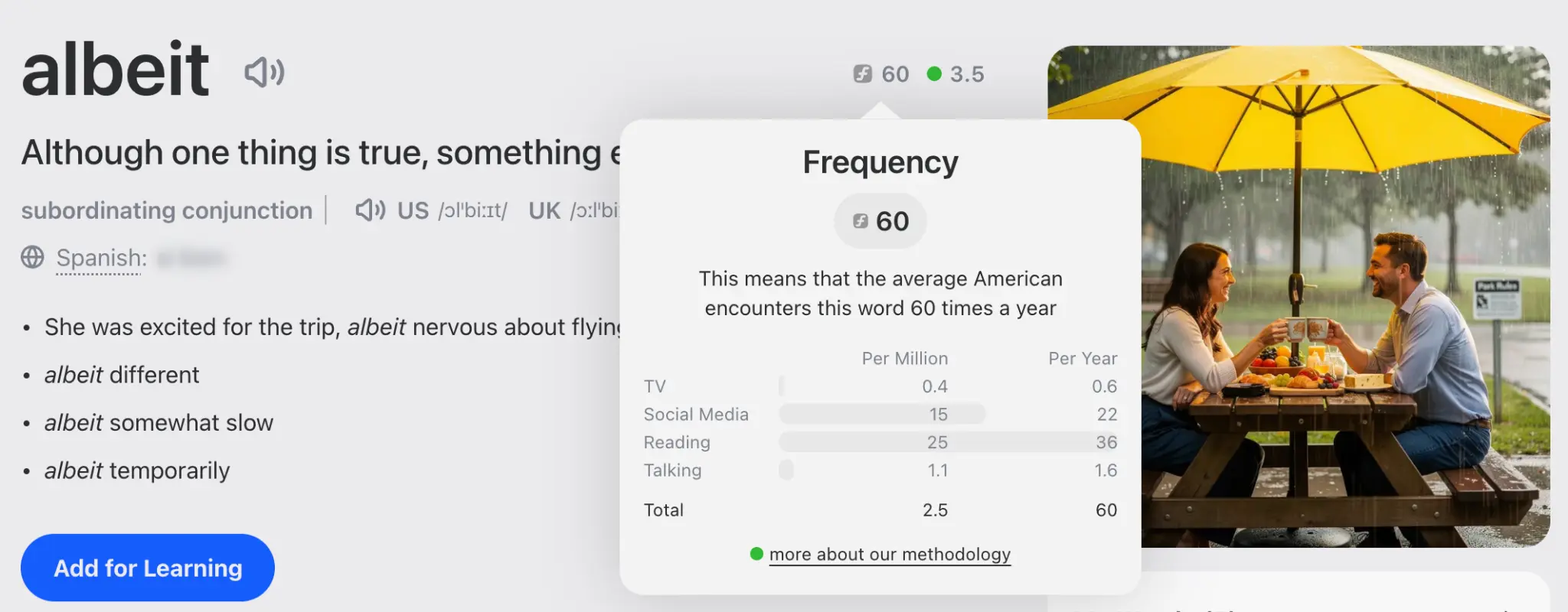
The interface groups the sources into TV, Reading, Social Media and Talking. These are convenient labels: for example, the Social Media category uses web and blog-style sources. The pipeline also preserves pooled, mean and median corpus frequencies, because the exposure estimate answers a different question from a raw corpus count.
The annual number is a model, not a diary of an individual’s life. A researcher, a chef and a school student encounter different English. The corpus mix, accuracy of sense matching and assumed media habits all affect the estimate. It helps establish a general priority; a learner’s interests can change that priority.
How the Concept Extractor connects material to the dictionary
The dictionary supplies an inventory of learning concepts. The Concept Extractor identifies which of those concepts occur in text, audio or video. For English vocabulary, an important part of this is word sense disambiguation: deciding which meaning a word has in its particular context.
That connection makes several applications possible. A passage can lead to the right dictionary sense. Examples from different resources can be grouped around the same concept. A corpus can be counted by meaning. A book can be described by the concepts a reader would need to understand it.
The quality of the matching matters throughout. If an extractor repeatedly confuses two senses, their counts and example collections will also be confused. This is why expert-reviewed labels, SenseBench and our word sense disambiguation research belong alongside the dictionary. They test a component that these applications depend on.
How the Knowledge Predictor uses these concepts
Difficulty describes patterns across learners. Frequency describes patterns in language. The Knowledge Prediction model asks a personal question: given this learner’s history, how likely are they to know this concept now?
A generally difficult meaning may already be familiar to you through your job. An easy meaning may be a gap in your knowledge. Keeping the three signals separate lets a teaching system look for concepts that are useful, probably unknown and suitable to work on next.
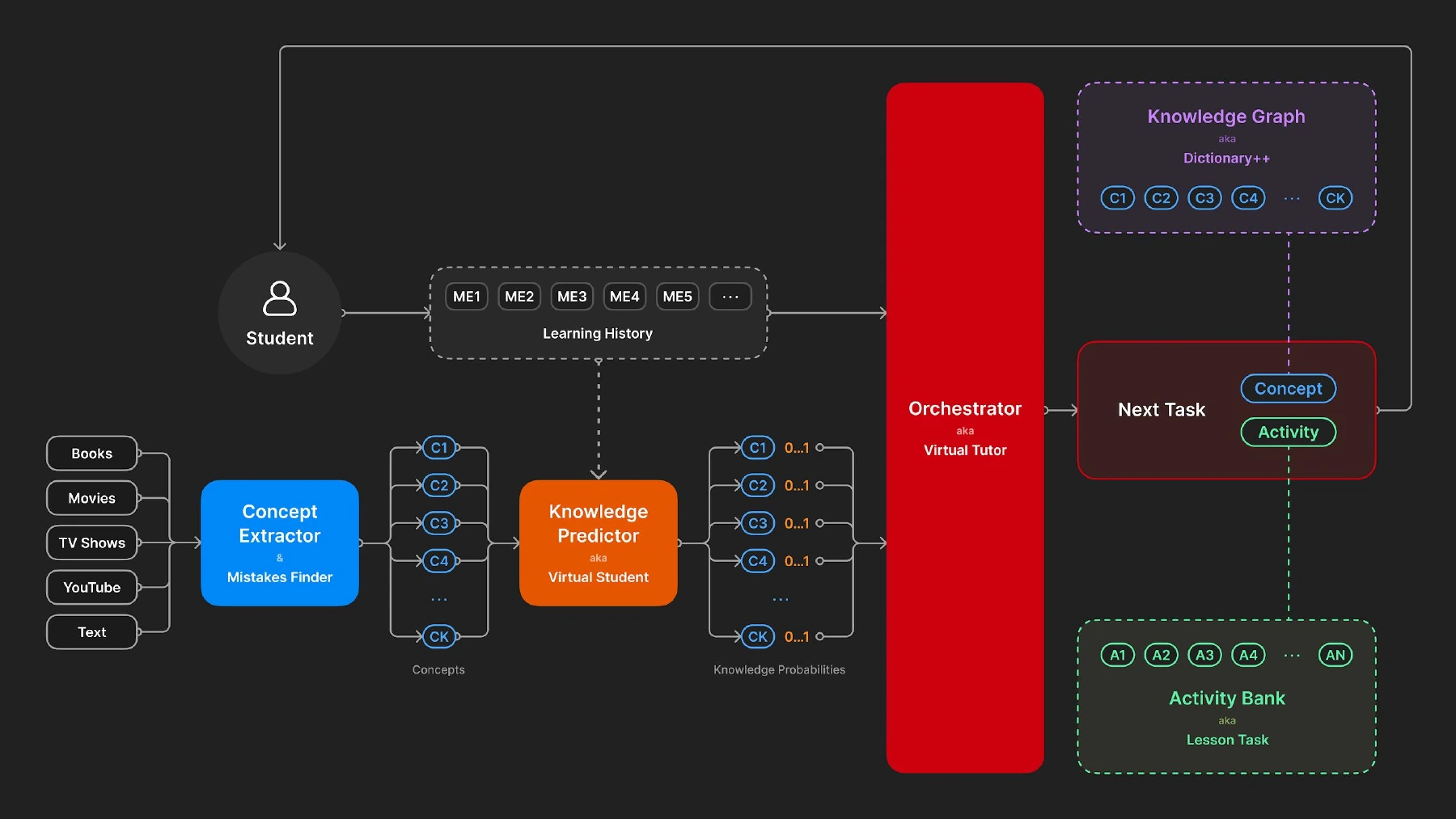
In the architecture, the teaching model combines these estimates with the learner’s goals and available activities to choose a next task. The learner’s response then adds evidence to their learning history. The dictionary gives these components a shared way to refer to what is being learned. Pavel’s N+1 article explains the full system.
This architecture describes how the components fit together. The dictionary’s current features, the evaluated extraction models and a complete adaptive teaching policy have different evidence behind them. Reliable definitions and predictions make better teaching decisions possible; whether those decisions improve learning must be tested with learners.